Philipp Baaske
EN DE

The mission

Build a new Mittelstand. Rooted in science.

I spent 17 years building one company: NanoTemper. Now, as Vice President for Entrepreneurship at LMU Munich, I work to make it easier for founders to turn research into companies that last.

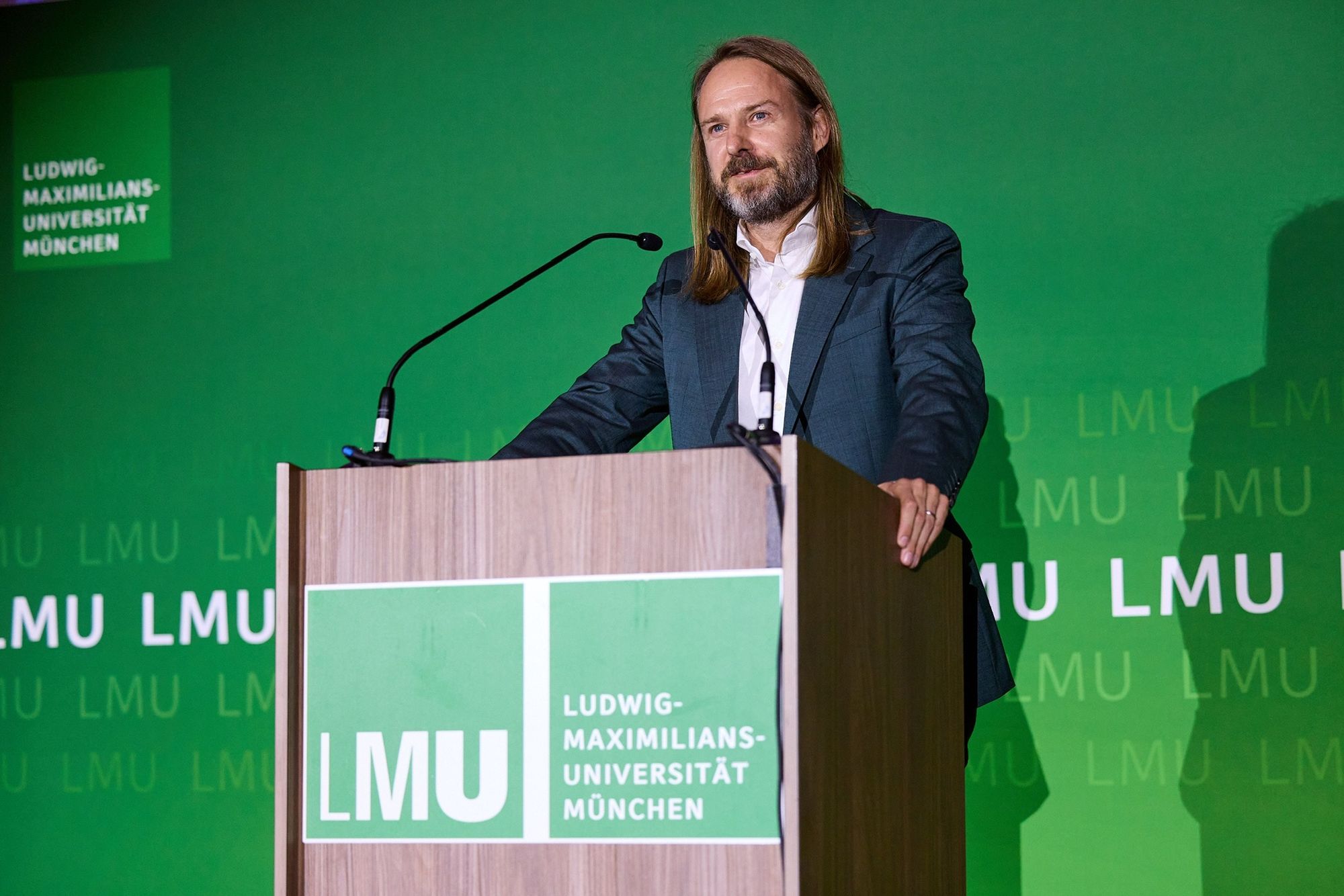
Philipp Baaske at LMU Munich © LMU

What changed

October 2025

I became Vice President for Entrepreneurship at LMU Munich — the point where my work turned. For seventeen years I built one company. Now I build the conditions under which others can build theirs.

I know exactly where a scientist loses time on the way out of the lab, because I lost it there myself.

What I want to help build

A new Mittelstand that comes out of science. Founded on research, based on European values, rooted deeply in society. Companies that create prosperity where they stand — and that build the high-tech products the world relies on.

The goal is not the start-up. That is the starting point. The goal is a profitable company built to last — creating jobs, paying taxes here, and helping fund the next one.

Sovereignty is not built by shutting the world out. It is built by creating high-tech companies whose products the world relies on.

The logic

Occupy the niche. Sovereignty and prosperity follow.

First

Occupy the niche

A Mittelstand out of research holds the high-tech niches the world depends on — before anyone else does.

Then

Sovereignty

The strategic goal. Build and sustain critical capabilities in Europe. So we can act with confidence and collaborate globally from a position of strength.

As a result

Prosperity

What sovereignty earns — and defends. Jobs and taxes created where these companies stand.

Already here

Nobody outside their industry has heard of these companies. The world runs on them anyway.

What is a Hidden Champion?

A term coined by economist Hermann Simon in 1990: a company that is number one, two or three worldwide — or number one on its home continent — in a niche so specialised the public has never heard of it. Germany already has roughly 1,600, most built decades ago out of workshops. The next generation will be rooted in science.

ASML, Netherlands

The one company advanced chipmaking cannot do without

The only maker of the EUV lithography machines that print the world’s most advanced chips, for AI, smartphones and data centres. Every leading semiconductor fab depends on them — and they in turn depend on German optics from Carl Zeiss.

SCANLAB, near Munich

The world’s leading independent maker of laser-scanning systems

About 40,000 systems shipped a year. Their scan heads steer the lasers that structure semiconductor chips, weld EV battery cells and drive industrial 3D printing — largely unknown outside the photonics industry.

Trumpf, Ditzingen

World leader in industrial lasers

Makes the high-power CO2 lasers that EUV lithography machines depend on for producing the world’s most advanced microchips.

Carl Zeiss SMT, Oberkochen

The optics behind modern chipmaking

Builds the most precise optical and mirror systems used in semiconductor manufacturing worldwide — a category with essentially no substitute.

The evidence — LMU Munich

3 months or faster. Six times faster than before — and only the start.

At LMU, transferring intellectual property from the university into a spin-out now takes three months or less. The German average is about 18 months — not to product, not to customer, not to financing, only to the contract. That is an acceleration by a factor of six. We have shown what is possible. And this is only the start.

We rebuilt that process. Not by pushing founders harder — by removing what was in their way.

Work with LMU Entrepreneurship
Reaction coordinate, technology transfer — a catalyst does not shine, it lowers the barrier
Activation barrier of a university IP transfer Two curves from the same starting point. Without a catalyst the barrier is high and takes about 18 months. With the LMU process the barrier is low and takes under 3 months. Uncatalysed — German average 18 months With a catalyst — LMU today under 3 months Idea in the lab Spin-out signed From lab result to signed IP transfer Barrier: time, loops, hierarchy

Source: EFI Gutachten 2026, p. 93

One desk

Decisions used to sit in many places across the university. We brought them into a single point of contact — a one-stop shop where founders get an answer instead of a referral.

Three into one

Three separate units became one. Fewer handovers, fewer places for a file to rest.

Five into two

Five hierarchy levels became two. Previously almost every decision travelled up to the president’s office and sometimes stayed there.

Standards, not cases

We created a legal framework inside which the team decides freely, instead of negotiating every case from scratch.

The result

Under three months to signature, and it keeps happening. The fastest transfer so far took two months and eight days.

A blockbuster drug earns at least a billion a year and is protected for at most twenty. Every month lost costs roughly 100 million euros — and that is before you count the patients who are waiting.

One Europe — the second barrier

Lab to company is barrier one. Border to border is barrier two.

On paper, Europe is a single market. In practice, scaling a company across it can still feel like starting over at every border.

Alfred Kammer, then head of the IMF’s European Department, put a number on it: internal EU barriers to trade may be equivalent to tariffs of around 44 percent on goods and 110 percent on services.

That is one reason the EU is now discussing „EU Inc.“, an optional 28th legal regime meant to make it easier to build and scale a company across Europe. But laws are only part of the problem — companies also need customers, partners, talent and capital across borders, not just fewer forms.

A good company does not become better because more people know its name. But it can grow faster when the right people and the right capital find it earlier.

Source: IMF, Alfred Kammer, Oct 2024 · IMF, Nov 2024
The structure

LMU Entrepreneurship Foundation

Acceleration only lasts if something carries it. A structure that pools capital, network, experience and responsibility.

This foundation invests in opportunities where others only see risk. It invests early, where others still wait for funding decisions. It invests in people, where others check forms.

It will not be a vault. It will be a catalyst.

I do not want to ask anyone for something I am not prepared to do myself. I am the first donor to this foundation — because I know what a single opportunity can change, and what is lost when it arrives too late.

How to take part

What this is not

Not

A call for more state money

Too little capital always exists and you can always use more. But start-ups do not become better companies simply by holding more money.

Not

A copy of Stanford

We are not building a Stanford in Munich. We are building a Munich model: fast, excellent, European and self-confident.

Not

A way for the university to get rich

We do not want to enrich ourselves through our spin-outs. Our spin-outs should enrich our society.

LMU Presidents’ Dinner, 21 May 2026

We do not accelerate contracts. We accelerate opportunities.

Who I want to reach

  • Researchers thinking about founding — so they can see that someone knows the path and has made it shorter.
  • Universities and policymakers — so they can see that this works and travels.
  • Entrepreneurs and investors driven by values, not only by profit — so they recognise themselves in the model.
  • Press and event organisers — so they can quote the position in one sentence.