The question scientists keep asking
For 17 years, I've watched the same conversation happen in labs around the world.
A scientist measures affinity — the binding strength between a protein and a small molecule. The data looks promising. So they move forward.
Then, weeks later, the compound fails in the next stage because it binds fast but dissociates even faster. Or it binds, but the protein unfolds. Or it works in vitro but not in cells.
They're back to square one.
The problem isn't their science. The problem is that affinity alone tells you one piece of a much larger story.
You need kinetics. How fast does it bind (kon)? How fast does it dissociate (koff)? A compound with perfect affinity but terrible kinetics won't work as a drug.
You need stability data. Will the protein unfold? Will it aggregate? These failures kill candidates downstream, wasting months and millions.
But here's the catch: Until now, you needed three different instruments to get all of this. Three different setups. Three times the sample requirement. Three times the complexity.
In mid-2026, we decided that was enough.
What Monolith Omni actually does
Monolith Omni is a benchtop platform that integrates four complementary biophysical measurement technologies into a single workflow. It's designed for the exact problem I just described.
1. Spectral Shift — Measures affinity (Kd) directly in solution. Your protein and compound interact. The fluorescence spectrum shifts. You get your binding constant. No surface attachment. No artifacts.
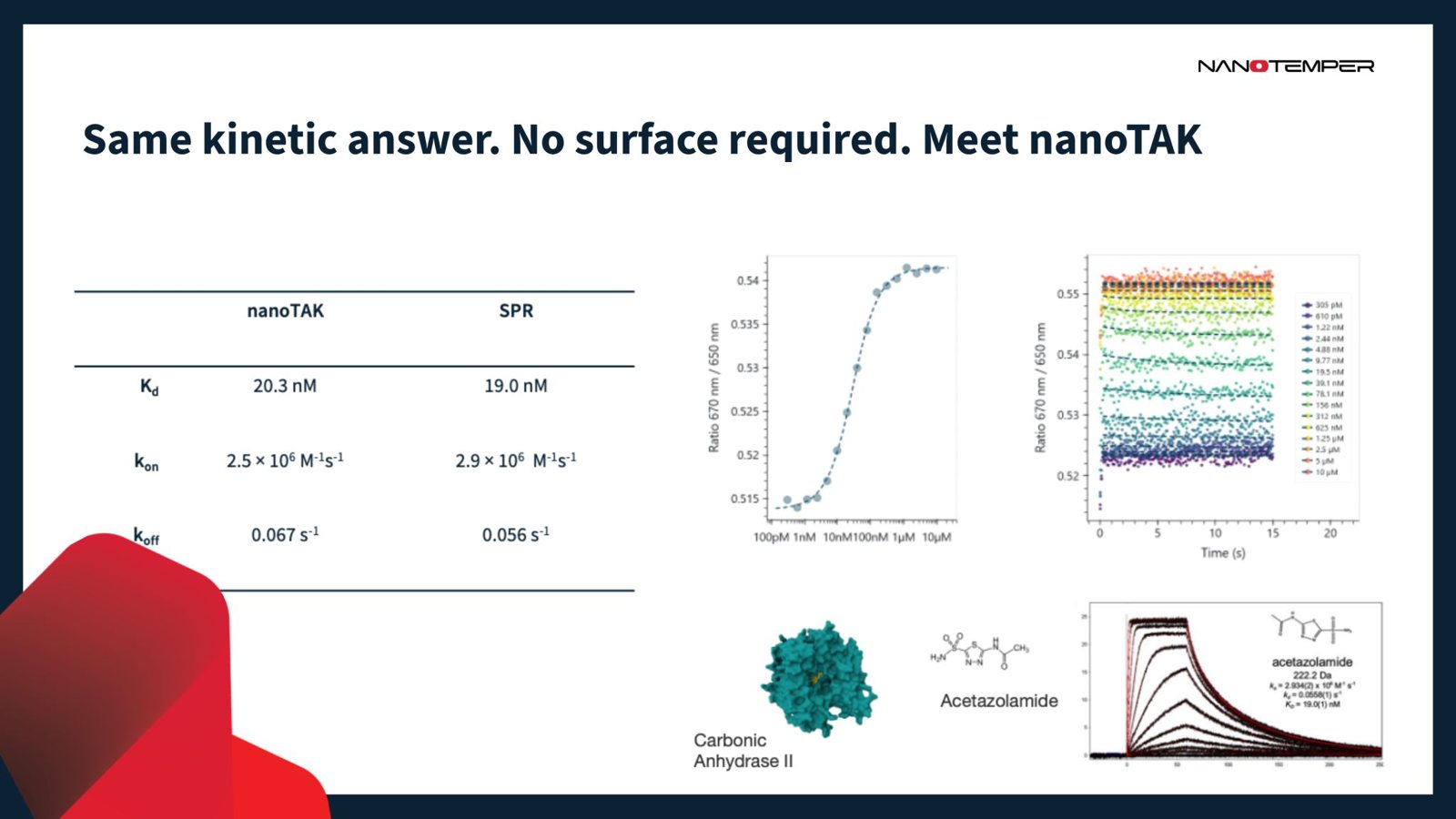
2. nanoTAK (nano Temperature Alteration Kinetics) — Measures binding kinetics (kon and koff rates) entirely in solution. This is the breakthrough part. Surface-based kinetics methods suffer from mass transport limitations — molecules pile up on the sensor surface, creating artificial bottlenecks. nanoTAK works in bulk solution, so you get real kinetics. The actual rates at which your molecules bind and unbind.
3. nanoLISA (nano Laser Induced Stability Analysis) — Detects protein unfolding and early aggregation at nanomolar concentrations, in seconds. You can catch stability problems before they become downstream disasters.
4. TRIC (Temperature Related Intensity Change) — Provides orthogonal readouts of thermal stability and protein state.
All four work together. From a single 10 µL sample, you get:
- Affinity constants (Kd)
- Binding kinetics (kon/koff)
- Thermodynamic parameters
- Protein stability and aggregation readouts
- All in one experiment. One workflow. One day of training.
Why this matters: the science behind the instrument
Here's what makes this different from everything that existed before.
No surface immobilization = no artifacts. Most affinity and kinetics platforms attach your target protein to a chip or sensor surface. This solves a technical problem — it makes measurement easier. But it creates a biological problem: your protein is now constrained, often denatured or partially unfolded, behaving in ways it never would in real cells.
Monolith Omni works entirely in solution. Your protein behaves like it would in nature. In buffers with detergent, if you're studying membrane proteins. In cell lysates, if you want to measure in a complex environment. In the exact conditions you care about.
Mass transport limitations don't apply. Surface-based kinetics methods have a blind spot: once your protein is attached to a surface, molecules diffusing to the surface don't represent the true on-rate. There's a diffusion component that makes everything look slower than it actually is. This is called "mass transport limitation."
nanoTAK measures kinetics in bulk solution, where these limitations disappear. You get the real kon and koff rates — the actual binding dynamics.
Sample efficiency = precious proteins preserved. 10 microliters per measurement. That's a capillary's worth. For labs working with difficult-to-produce targets — rare proteins, engineered constructs, cell-derived samples — this changes everything. You can run comprehensive characterization experiments without running out of protein.
Modality range = all modern drug modalities. Small molecules, peptides, proteins, nucleic acids, PROTACs (protein degraders), molecular glues, degrader-induced ternary complexes — Monolith Omni handles all of it without workflow changes. This matters because drug discovery isn't just fragments and small molecules anymore. TPD (Targeted Protein Degradation) is a new frontier, and you need biophysical tools that speak that language.
A concrete example: why this would have helped in 2009
When we sold our first Monolith instrument to Crelux GmbH in December 2009, they were running fragment-based drug discovery. Their workflow was:
- Screen a library of fragments
- Measure affinity for hits
- Send hits to biochemistry team to validate kinetics
- Run stability assays separately
- Decide which ones to optimize
That's at least three teams, three handoffs, and three weeks of turnaround time.
With Monolith Omni, that same workflow becomes:
- Screen library of fragments
- Measure affinity, kinetics, and stability in one experiment
- Hand the complete interaction profile to the optimization team
- Start chemistry immediately
Same question. Different answer timeline.
Why membrane proteins (and PROTACs) changed everything
When we started the research behind NanoTemper in 2006, we were focused on a specific problem: soluble proteins. Protein-ligand interactions in aqueous solution.
Over the years, the labs we worked with kept asking: "Does this work with membrane proteins?"
The honest answer was: Not really. Our technology could measure in detergent, but the workflow was clunky. Detergent denatures proteins. You get artifacts.
Monolith Omni works with detergent-solubilized membrane proteins and maintains protein integrity. You get real measurements in realistic conditions.
And then, around 2020, a new class of drug targets emerged: protein degraders. Instead of inhibiting a protein, you destroy it. You force two proteins together — the target and an E3 ligase — and your linker molecule (the degrader) holds them together long enough for the cell to destroy the target.
This creates complex ternary interactions (a three-body problem): Target + Degrader + E3 Ligase.
Surface-based methods struggle with this. The complex is large, dynamic, and easily disrupted.
In solution? Monolith Omni handles it natively.
The philosophy behind the product
This is the part that matters most to me, as a founder.
In 2006, when we discovered the fundamental technology — measuring biophysical properties via thermophoresis — we made a bet: Better measurement tools enable better science.
Not faster. Not cheaper (though those things matter). Better. More accurate. More complete. Measurement that reveals reality instead of imposing limitations.
That philosophy has run through every product we've built. And Monolith Omni is the fullest expression of it yet.
We integrated four different measurement modalities because the scientists asked for it. We built it to work in solution because that's where biology happens. We kept the sample volume at 10 microliters because we respect how hard it is to produce certain proteins. We expanded the modality range to include PROTACs and degraders because drug discovery is moving in that direction.
Every design decision came from listening to what the labs actually needed, not what was easiest to engineer.
What installation and training look like
Here's another thing that matters: Productive from day one.
Installation and training complete in a single day. The software is intuitive — it guides users through assay setup and automatically generates publication-quality outputs.
This sounds like a detail. It's actually everything.
Complex instruments sit in labs unused. Not because the science is wrong, but because adoption friction kills adoption. If you need a week of training, three certifications, and a PhD in optics to use the tool, you've already lost half your potential users.
Monolith Omni was designed to be used. By competent scientists, not specialists. Without a learning curve that kills adoption.
Why this matters right now (2026)
We're at an inflection point in drug discovery.
Small molecule screens are getting more competitive. Fragment-based approaches are more accessible. But biologics, degraders, TPD, and cell-based approaches are becoming mainstream. These require different measurement approaches.
At the same time, labs are getting smaller, budgets are getting tighter, and the pressure to do more with less sample is increasing.
Monolith Omni exists because those two trends collided.
We had 10,000+ scientists using our tools worldwide. They kept pushing us to make measurements that were previously impossible. Affinity + kinetics + stability simultaneously. In membrane proteins. In cell lysates. In real conditions. With minimal sample.
We listened.
The technical specs (if you care about precision)
- Sample requirements: 10 µL per capillary
- Affinity (Kd): via Spectral Shift
- Binding kinetics (kon/koff): via nanoTAK
- Protein stability & aggregation: via nanoLISA
- Thermal parameters: via TRIC
- Modalities supported: small molecules, peptides, proteins, nucleic acids, PROTACs, molecular glues, degrader-induced ternary complexes
- Conditions: entirely in-solution. Works in buffer, detergent, cell lysates, and complex biological matrices.
- Surface immobilization: none. All measurements in solution.
- Turnaround: complete characterization in hours, not days.
- Workflow: automated setup, guided analysis, publication-ready outputs.
What comes next
Monolith Omni launched in mid-2026, and it's already changing how labs approach target characterization.
We're hearing the same feedback: "We didn't realize how much we were missing with affinity-only screening."
That's the validation we needed. Not because it's good for NanoTemper. Because it means scientists can ask better questions now. And better questions lead to better drugs, faster.
Your question
If you're running drug discovery right now — whether it's fragments, small molecules, biologics, or degraders — ask yourself:
Are you measuring affinity and stopping there? Or are you asking the deeper questions: How fast does it bind? How stable is the complex? Does this behavior in solution match what you predicted?
Because that's the difference between a compound that looks good on paper and one that actually works.
More about the instrument: Monolith Omni at NanoTemper Technologies
About the author: Philipp Baaske co-founded NanoTemper Technologies in 2008, two years after discovering a measurement technology that would transform biophysical characterization. Today, 10,000+ scientists worldwide use NanoTemper tools. Monolith Omni represents the culmination of 20 years of listening to what labs actually need. He writes about this and other founder lessons in Ein ehrbarer Entrepreneur (The Honorable Entrepreneur).